Recently Brett Fishburne was going through some donated books and came across a copy of “Trench on Words”, which is already in the PG collection (text #6480), that had a newspaper review glued to the front.
The newspaper title from which the review was printed was not in the information that was glued to the front of the book. He believes that the newspaper was from Buffalo, New York and the review to have been written in 1928. Parts of the review were torn and lost, but thinks he was able to accurately fill in the words (placed in square brackets) that were missing. He believes with some certainty that this review did not come from the New York Times as he researched their archives thoroughly.
pgweekly_2007_02_14.txt
The Project Gutenberg Weekly Newsletter for Wednesday, February 14, 2007
****eBooks Readable by Both Humans and Computers since July 4, 1971****

http://www.gutenberg.org

NOTE: Best viewed with a fixed-width font, i.e. Courier New.
      Windows NotePad is a good a program to use for viewing.


THIS WEEKS NEWS
---------------

          MAJOR UPDATE OF THE PROJECT GUTENBERG NEWSLETTER STATISTICS

For sometime I've been working through the Newsletter Archives doing a manual
count on ALL the 'posted' listings, then entering the results into a
spreadsheet. I wanted to confirm that all the statistics added up correctly.
There was some inconsistencies but I believe that now it is a much more
accurate week-by-week, year-by-year account.

As a result there will be some differences in the numbers previously recorded
in the newsletters. Therefore I have put together an article to show these
new yearly statistics for each year since 2001.

Notes of interest include;

* 3,042 is the starting figure for 2001 (previously thought to be 3,100)
* Almost all of the DP-EU books have been posted to the PG site. These
  duplicates are now subtracted from the totals. Both overall and unique
  totals will be shown.
* PG U.S. total includes the PG-EU 'non-unique' figures as these are still a
  part of that count.
* REposted total had to be adjusted at the end of 2006 as it was found that a
  number of reposts were not documented in any newsletter listings.

This is neither a fully accurate nor definitive count, but it certainly
brings us another step closer to that goal.

TO VIEW THE NEW STATISTICS VISIT: https://www.gutenbergnews.org/content/view/173/34/


NEWS HEADLINES -- Visit www.gutenbergnews.org to read these news items.

* PG Reserved / Pending List
* Unwrapping Paragraphs in a PG eBook - A HOWTO
* Digital Text Masters (Digitizing the classic public domain books)
* Nelson W. Polsby, 72, Author and a Scholar of Politics, Dies
* The Ecstasy of Influence


To submit a news item please email editor_AT_gutenbergnews.org


HOW TO ACCESS (DOWNLOAD) PG EBOOKS
----------------------------------

http://www.gutenberg.org/find
To search by title, author, language and subject.

http://www.gutenberg.org/dirs/ || ftp://ibiblio.org/pub/docs/books/gutenberg/
If you know the file's name then point your web browser or FTP program to one
of our master download sites, navigate to the appropriate directory and look
for the first five characters of the file's name. Note that updated eBooks
usually go in their original directory (e.g., etext99, etext00, etc.)

Cell-Phone Ready eBooks
-----------------------

MOBILEBOOKS - http://www.mobilebooks.org
There are over 5,000 PG eBooks in Java (.jar) format that can be downloaded
from the MobileBooks website. There are help pages at the website on how to
use these eBooks on your phone.

WATTPAD - http://www.wattpad.com
This is a free service for reading and sharing stories on your mobile phone.
Once downloaded to your phone you'll instantly get access to nearly 20,000
works from Project Gutenberg.


WANTED ADS
----------
Project Gutenberg is looking for Volunteers. To learn how you can help
please visit the Volunteers Wanted! Section at:

https://www.gutenbergnews.org

CURRENT 'WANTED' HEADLINES:
  * Our Distributed Proof Readers Need...
  * Project Gutenberg Is Seeking Legal Beagles
  * Graphics needed for PG website and publicity materials
  * Turn eBooks into MP3
  * Project Gutenberg Needs DVD Burners
  * "SF" for PG Australia

==============================[ PROGRESS REPORT ]===============================

Year: 2007
This Completes - Day: #042/364 | Week: #06 | Month: #01.50
322 days / 46 weeks of the year remaining.

GRAND TOTALS

20,537 [+ 40] PG U.S.
 1,475 [+  3] PG Australia
   422 [+  0] PG Europe | 68 [+ 0] Unique
   381 [+  0] PG PrePrints
============
22,461 [+ 43] GRAND TOTAL [Using PG-EU Unique Count Only]

    43 - Reserved/Pending

 7,539 to go to 30,000 eBooks.

  ~75% of the way to 30,000
  ~24% of the way from 20,000 to 30,000

 1,881 [+ 0] eBooks REposted to the new filing system since 18 May 2004.


STATISTICS FOR 2007

  322 PG U.S.
   21 PG Australian
   14 PG Europe | 3 Unique
    0 PG PrePrints
=====
  346 TOTAL [2007] [Using PG-EU Unique Count Only]

   13 eBooks REposted to the new filing system.

    * 43 new eBooks this week
    * 43 new eBooks last week
    * 85 new eBooks this month [Feb]

[Our production year begins/ends 1st Wednesday of the year]


HISTORICAL COMPARISONS

Weekly Averages:

   * 57 per week in 2007
   * 80 per week in 2006
   * 58 per week in 2005
   * 78 per week in 2004
   * 79 per week in 2003
   * 47 per week in 2002
   * 24 per week in 2001

Monthly Averages:

   * 229 per month in 2007
   * 346 per month in 2006
   * 251 per month in 2005
   * 338 per month in 2004
   * 348 per month in 2003
   * 203 per month in 2002
   * 104 per month in 2001

Yearly Totals:

   *  346 new eBooks in 2007
   * 4146 new eBooks in 2006
   * 3017 new eBooks in 2005
   * 4058 new eBooks in 2004
   * 4176 new eBooks in 2003
   * 2432 new eBooks in 2002
   * 1244 new eBooks in 2001


   * 3042 eBooks posted from 1971-2000

19,419 new eBooks since the start of 2001. ~264 eBooks p/m for 73.50 months.


NOTES:

To arrive at the Newsletter statistics a manual count was done on all the
'posted' listings found in the Newsletter Archives. For PG-EU the website
listing was used. All these statistics were then entered into a speadsheet.

DP-EU is currently concentrating on U.S. copyright clearable eBooks and
therefore many of these are posted to both the PG and PG-EU sites, although
there are some non U.S. clearable books posted to PG-EU only. At the end of
2006 the non-clearable number was 65. This is a first stage count using the
Newsletter Archives as source. Eventually those will be checked against the
gutenberg.org online database.

PREPRINTS -- http://preprints.readingroo.ms
Please note that the PrePrint files are just that, PrePrints, and thus may
move later to other locations, including the main collection or The Project
Gutenberg Consortia Center.

==============================[ OTHER STATISTICS ]==============================

DISTRIBUTED PROOFREADERS (DP)
9,872 [+28] at Distributed Proofreaders.

Distributed Proofreaders started production in October 2000 and currently
has over 52,000 volunteers.

For more information about DP please visit: http://www.pgdp.net


DISTRIBUTED PROOFREADERS OF EUROPE (DP-EU)
DP-EU Total matches the PG-EU Grand Total. See Progress Report.

Distributed Proofreaders of Europe started production in December 2003 and
currently has over 1,500 volunteers.

For more information about DP-EU please visit: http://dp.rastko.net


SNAIL MAIL (DVD & CD)
Over 15 million eBooks have been sent out via snail mail!!!


PGCC - PROJECT GUTENBERG CONSORTIA CENTER
82,383 eBooks [as of 18-December-2006]

The PGCC is currently updating their servers, once complete their eBook
collection will be expanded considerably. These updates are expected to be
completed early 2007.

PGCC Collections include;

Alex Catalogue of Electronic Texts, Blackmask Online,
Books@Adelaide Collection, CIA's Electronic Reading Room,
PGCC Classic Chinese Literature, The Coradella Bookshelf Collection,
DjVu Collection, eBooks Libres & Gratuits, Himalayan Academy,
Internet Archive (eMovies), Literal Systems, Logos Group Collection,
Poets' Collection, Project Gutenberg Collection,
PSU's Electronic Classics Series, Renascence Editions Collection,
The Rosetta Project, Swami Center, Dr Widger Library

http://www.gutenberg.cc


THE ONLINE BOOKS PAGE
27,000 eBooks via The Online Books Page. [as of 01-December-2006]

NOTE: 6,400 of these are from PG.

http://onlinebooks.library.upenn.edu


=====================[ UPDATED LISTINGS FOR THE PAST WEEK ]=====================

To report an error in the following listings, please write to help_at_pglaf.org
and include the word CORRECTION in the subject line.

Please note that the Project Gutenberg Production Team continues the process
of manually re-posting those eBooks originally posted prior to Nov 2003 to the
new filenaming and directory system (based on the eBook number). This process
includes some file maintenance (repairing, correcting and re-formatting to
current PG standards where practicable).

---------[   0 REPOSTED TO NEW DIRECTORY SYSTEM ]-------------------------------

The following eBooks have been manually updated and reposted with the
indicated filenames and transferred into the corresponding new directories:

None this week.


---------[   2 CHANGES/CORRECTIONS/IMPROVEMENTS ]-------------------------------

Corrected to include the volume number.
The Palace of Pleasure, Volume 1, by William Painter                     20241
  [Link: http://www.gutenberg.org/2/0/2/4/20241 ]
  [Files: 20241.txt; 20241-8.txt; 20241-0.txt; 20241-h.htm]

Corrected and an html file has been provided.
Bell's Cathedrals: The Churches of Coventry, by Frederic W.  Woodhouse   11403
  [Subtitle: A Short History of the City and Its Medieval Remains]
  [Link: http://www.gutenberg.org/1/1/4/0/11403 ]
  [Files: 11403.txt; 11403-8.txt; 11403-h.htm]


---------[  40 NEW PG EBOOK(S) ]----------------------------------------------

Napoleon the Little, by Victor Hugo                                      20580
  [Link: http://www.gutenberg.org/2/0/5/8/20580 ]
  [Files: 20580.txt; 20580-8.txt; 20580-h.htm]

The Frog Who Would A Wooing Go, by Charles Bennett                       20579
  [Link: http://www.gutenberg.org/2/0/5/7/20579 ]
  [Files: 20579.txt; 20579-h.htm]

Sermons on Biblical Characters, by Clovis G. Chappell                    20578
   [Link: http://www.gutenberg.org/2/0/5/7/20578 ]
   [Files: 20578.txt]

La Folle Journée, by Pierre Augustin Caron de Beaumarchais               20577
  [Full title: La Folle Journée ou le Marriage de Figaro]
  [Language: French]
  [Link: http://www.gutenberg.org/2/0/5/7/20577 ]
  [Files: 20577-8.txt; 20577-0.txt; 20577-h.htm]

Two Suffolk Friends, by Francis Hindes Groome                            20576
   [Link: http://www.gutenberg.org/2/0/5/7/20576 ]
   [Files: 20576.txt; 20576-h.htm]

My Dog Tray, by Unknown                                                  20575
   [Illustrator: H. W. Petherick]
   [Link: http://www.gutenberg.org/2/0/5/7/20575 ]
   [Files: 20575.txt; 20575-h.htm]

O Mysterio da Estrada de Cintra, by Queiroz and Ortigão                  20574
  [Full author: José Maria Eça de Queiroz and Ramalho Ortigão]
  [Subtitle: Cartas ao Diário de Noticias, terceira edição]
  [Language: Portuguese]
  [Link: http://www.gutenberg.org/2/0/5/7/20574 ]
  [Files: 20574-8.txt]

Lalli, by Evald Ferdinand Jahnsson                                       20573
  [Subtitle: Murhenäytelmä viidessä näytöksessä]
  [Language: Finnish]
  [Link: http://www.gutenberg.org/2/0/5/7/20573 ]
  [Files: 20573-8.txt]

Marie Claire, by Marguerite Audoux                                       20572
  [Translator: John N.  Raphael]
  [Link: http://www.gutenberg.org/2/0/5/7/20572 ]
  [Files: 20572.txt; 20572-8.txt; 20572-h.htm]

Woman's Work in Music, by Arthur Elson                                   20571
  [Link: http://www.gutenberg.org/2/0/5/7/20571 ]
  [Files: 20571.txt; 20571-8.txt; 20571-h.htm]

A penalidade na India segundo o Código de Manu, by A. C. de Figueiredo   20570
  [Full author: António Cândido de Figueiredo]
  [Language: Portuguese]
  [Link: http://www.gutenberg.org/2/0/5/7/20570 ]
  [Files: 20570-8.txt]

Dulcibel, by Henry Peterson                                              20569
  [Subtitle: A Tale of Old Salem]
  [Illustrator: Howard Pyle]
  [Link: http://www.gutenberg.org/2/0/5/6/20569 ]
  [Files: 20569.txt; 20569-8.txt; 20569-h.htm]

Hombres, by Paul Verlaine                                                20568
  [Subtitle: (Hommes)]
  [Language: French]
  [Link: http://www.gutenberg.org/2/0/5/6/20568 ]
  [Files: 20568-8.txt]

The Pigeon Tale, by Virginia Bennett                                     20567
  [Illustrator: E. Stuart Hardy]
  [Link: http://www.gutenberg.org/2/0/5/6/20567 ]
  [Files: 20567.txt; 20567-8.txt; 20567-h.htm]

Rogers-isms, the Cowboy Philosopher on the Peace Conference, Will Rogers 20566
  [Link: http://www.gutenberg.org/2/0/5/6/20566 ]
  [Files: 20566.txt; 20566-h.htm]

The Continental Monthly, Vol. 6, No 2,  August, 1864, by Various         20565
  [Subtitle: Devoted to Literature and National Policy]
  [Link: http://www.gutenberg.org/2/0/5/6/20565 ]
  [Files: 20565.txt; 20565-8.txt; 20565-h.htm]

La Confession de Talleyrand, V. 1-5, by Talleyrand                       20564
  [Full author: Charles-Maurice de Talleyrand-Périgord]
  [Subtitle: Mémoires du Prince de Talleyrand]
  [Editor: Albert de Broglie]
  [Language: French]
  [Link: http://www.gutenberg.org/2/0/5/6/20564 ]
  [Files: 20564-8.txt; 20564-h.htm]

Terry, by Charles Goff Thomson                                           20563
  [Subtitle: A Tale of the Hill People]
  [Link: http://www.gutenberg.org/2/0/5/6/20563 ]
  [Files: 20563.txt; 20563-8.txt; 20563-h.htm]

Voyages, by Théodore Aynard                                              20562
  [Language: French]
  [Link: http://www.gutenberg.org/2/0/5/6/20562 ]
  [Files: 20562-8.txt; 20562-h.htm]

Little Ferns For Fanny's Little Friends, by Fanny Fern                   20561
  [Link: http://www.gutenberg.org/2/0/5/6/20561 ]
  [Files: 20561.txt; 20561-h.htm]

Letters to His Friends, by Forbes Robinson                               20560
  [Link: http://www.gutenberg.org/2/0/5/6/20560 ]
  [Files: 20560.txt; 20560-8.txt; 20560-h.htm]

R. Holmes & Co., by John Kendrick Bangs                                  20559
  [Link: http://www.gutenberg.org/2/0/5/5/20559 ]
  [Files: 20559.txt; 20559-8.txt]

The Merry-Thought, Part 1, by Johnson                                    20558
  [Full title: The Merry-Thought: or the Glass-Window and Bog-House
                Miscellany. Part 1]
  [Full author: Samuel Johnson [AKA Hurlo Thrumbo]]
  [Commentator: George R. Guffey]
  [Contributor: James Roberts]
  [Link: http://www.gutenberg.org/2/0/5/5/20558 ]
  [Files: 20558.txt; 20558-h.htm]

Ontario Teachers' Manuals, by Ministry of Education Ontario              20557
  [Full title: Ontario Teachers' Manuals: Household Science in Rural
                Schools]
  [Link: http://www.gutenberg.org/2/0/5/5/20557 ]
  [Files: 20557.txt; 20557-8.txt; 20557-h.htm]

Lamarck, the Founder of Evolution, by Alpheus Spring Packard             20556
  [Subtitle: His Life and Work]
  [Link: http://www.gutenberg.org/2/0/5/5/20556 ]
  [Files: 20556.txt; 20556-8.txt; 20556-h.htm]

What Is and What Might Be, by Edmond Holmes                              20555
   [Subtitle: A Study of Education in General and Elementary
              Education in Particular]
   [Link: http://www.gutenberg.org/2/0/5/5/20555 ]
   [Files: 20555.txt; 20555-8.txt; 20555-h.htm]

Nos Hommes et Notre Histoire, by Rodolphe Lucien Desdunes                20554
   [Subtitle: Notices biographiques accompagnées de reflexions et de
              souvenirs personnels]
   [Language: French]
   [Link: http://www.gutenberg.org/2/0/5/5/20554 ]
   [Files: 20554-8.txt; 20554-h.htm]

Out Around Rigel, by Robert H. Wilson                                    20553
   [Link: http://www.gutenberg.org/2/0/5/5/20553 ]
   [Files: 20553.txt; 20553-h.htm]

Roumanian Fairy Tales, by Various                                        20552
   [Compiler: Mite Kremnitz]
   [Editor: J. M. Percival]
   [Link: http://www.gutenberg.org/2/0/5/5/20552 ]
   [Files: 20552.txt; 20552-h.htm]

The White Invaders, by Raymond King Cummings                             20551
   [Link: http://www.gutenberg.org/2/0/5/5/20551 ]
   [Files: 20551.txt; 20551-h.htm]

Presten som ikke kunde brukes, by Carl Edin Nordberg                     20550
  [Commentator: Paul Winther]
  [Language: Norwegian]
  [Link: http://www.gutenberg.org/2/0/5/5/20550 ]
  [Files: 20550-8.txt; 20550-0.txt; 20550-h.htm]

Historical Tales, Vol. 9 (of 15), by Charles Morris                      20549
  [Subtitle: The Romance of Reality. Scandinavian.]
  [Link: http://www.gutenberg.org/2/0/5/4/20549 ]
  [Files: 20549.txt; 20549-8.txt; 20549-h.htm]

The Secret of the Storm Country, by Grace Miller White                   20548
  [Illustrator: Lucius W. Hitchcock]
  [Link: http://www.gutenberg.org/2/0/5/4/20548 ]
  [Files: 20548.txt; 20548-h.htm]

Stories of Birds, by Lenore Elizabeth Mulets                             20547
  [Link: http://www.gutenberg.org/2/0/5/4/20547 ]
  [Files: 20547.txt; 20547-h.htm]

The Hand in the Dark, by Arthur J. Rees                                  20546
  [Link: http://www.gutenberg.org/2/0/5/4/20546 ]
  [Files: 20546.txt; 20546-8.txt; 20546-h.htm]

Pukkisen pidot, by Robert Kiljander                                      20545
  [Subtitle: Kaksinäytöksinen huvinäytelmä]
  [Language: Finnish]
  [Link: http://www.gutenberg.org/2/0/5/4/20545 ]
  [Files: 20545-8.txt]

The Little Skipper, by George Manville Fenn                              20544
  [Subtitle: A Son of a Sailor]
  [Link: http://www.gutenberg.org/2/0/5/4/20544 ]
  [Files: 20544.txt; 20544-h.htm]

Edward FitzGerald and "Posh", by James Blyth                             20543
   [Subtitle: "Herring Merchants"]
   [Link: http://www.gutenberg.org/2/0/5/4/20543 ]
   [Files: 20543.txt; 20543-h.htm]

Het Leven der Dieren, by A. E. Brehm                                     20542
  [Subtitle: Hoofdstuk 8: De Tandeloozen; Hoofdstuk 9: De Slurfdieren;
              Hoofdstuk 10: De Onevenvingerigen]
  [Language: Dutch]
  [Link: http://www.gutenberg.org/2/0/5/4/20542 ]
  [Files: 20542-8.txt; 20542-h.htm]

The Rocky Island, by Samuel Wilberforce                                  20541
   [Subtitle: and Other Similitudes]
   [Link: http://www.gutenberg.org/2/0/5/4/20541 ]
   [Files: 20541.txt; 20541-h.htm]


---------[   3 NEW PG AUSTRALIA EBOOK(S) ]--------------------------------------

Feb 2007 The Charwoman's Daughter, James Stephens          [070022xx.xxx] 1475A
http://gutenberg.net.au/ebooks07/0700221.txt or .zip
http://gutenberg.net.au/ebooks07/0700221h.html

Feb 2007 My Apprenticeship Vol 2, Beatrice Webb            [070021xx.xxx] 1474A
http://gutenberg.net.au/ebooks07/0700211.txt or .zip
http://gutenberg.net.au/ebooks07/0700211h.html

Feb 2007 My Apprenticeship Vol 1, Beatrice Webb            [070020xx.xxx] 1473A
http://gutenberg.net.au/ebooks07/0700201.txt or .zip
http://gutenberg.net.au/ebooks07/0700201h.html


For more information about Project Gutenberg of Australia, including
accessing those eBooks from outside of Australia, please visit:
http://gutenberg.net.au


---------[   0 NEW PG EUROPE 'UNIQUE' EBOOK(S) ]--------------------------------

None this week.


This listing is for PG-EU eBooks that are not U.S. copyright clearable and so
are posted to the PG-EU site only.

For more information about Project Gutenberg of Europe please visit:
http://pge.rastko.net

--------------------------------------------------------------------------------

For more information on copyright restrictions in general please visit:
http://onlinebooks.library.upenn.edu/okbooks.html

================================================================================

gweekly mailing list
gweekly@lists.pglaf.org
http://lists.pglaf.org/listinfo.cgi/gweekly
For sometime I’ve been working through the Newsletter Archives doing a manual count on all the ‘posted’ listings, then entering the results into a spreadsheet. I wanted to confirm that all the statistics added up correctly. There was some inconsistencies but I believe that now it is a much more accurate week-by-week, year-by-year account.
As a result there will be some differences in the numbers previously recorded in the newsletters. Therefore I have put together this article to show these new yearly statistics for each year since 2001.
Notes of interest include;
3,042 is the starting figure for 2001 (previously thought to be 3,100)
Almost all of the DP-EU books have been posted to the PG site. These duplicates are now subtracted from the totals. Both overall and unique totals will be shown.
PG U.S. total includes the PG-EU ’non-unique’ figures as these are still a part of that count.
REposted total had to be adjusted at the end of 2006 as it was found that a number of reposts were not documented in any newsletter listings.
This is neither a fully accurate nor definitive count, but it certainly brings us another step closer to that goal.
The following is a listing of all the entries on the Project Gutenberg Reserved/Pending list. These numbers have been reserved for various reason and at present there is no date as to when they will get posted.
Reserved / Pending
gbnewby                                              20000
Reserved            "The Road Leads On, by Knut Hamsun"                   7536
Reserved            "The Arabian Nights Entertainments Volume 2, Anon."   5613
Reserved / Pending  Unknown                                               3018
Reserved / Pending  Unknown                                               2879
Reserved            "Added Upon a Story, by Nephi Anderson"               2877
Reserved / Pending  Unknown                                               2738
Reserved            "The Home Book of Verse, by Burton E. Stevenson V8"   2626
Reserved            "The Home Book of Verse, by Burton E. Stevenson V7"   2625
Reserved            "The Home Book of Verse, by Burton E. Stevenson V6"   2624
Reserved            "The Home Book of Verse, by Burton E. Stevenson V5"   2623
Reserved            "Human Genome Project, About the Human Genome Files"  2200
Reserved            "The Original Writings of Samuel Adams, Volume 1"     2091
Reserved            "2001, by Arthur C. Clarke"                           2001
Reserved            "1984, by George Orwell (Did it come true?)"          1984
Reserved            Pietro di Miceli (former PG Webmaster )               1964
Reserved            Reserved for WWI                                      1914
Reserved            "Twelfth-Night, by William Shakespeare"           WL  1789
Reserved            Reserved for Shakespeare                          WL  1767
Reserved            Reserved for Shakespeare                          WL  1766
Reserved            "I Have A Dream, Martin Luther King, Jr."             1691
Pending             Unfilled                                              1648
Pending             Unfilled                                              1647
Pending             Unfilled                                              1255
Reserved            The Project Gutenberg Encyclopedia                     199
Reserved            The Project Gutenberg Encyclopedia                     198
Reserved            The Project Gutenberg Encyclopedia                     197
Reserved            The Project Gutenberg Encyclopedia                     196
Reserved            The Project Gutenberg Encyclopedia                     195
Reserved            The Project Gutenberg Encyclopedia                     194
Reserved            The Project Gutenberg Encyclopedia                     193
Reserved            The Project Gutenberg Encyclopedia                     192
Reserved            The Project Gutenberg Encyclopedia                     191
Reserved            The Project Gutenberg Encyclopedia                     190
Reserved            The Project Gutenberg Encyclopedia                     189
Reserved            The Project Gutenberg Encyclopedia                     188
Reserved            The Project Gutenberg Encyclopedia                     187
Reserved            The Project Gutenberg Encyclopedia                     186
Reserved            The Project Gutenberg Encyclopedia                     185
Reserved            The Project Gutenberg Encyclopedia                     184
Reserved            The Project Gutenberg Encyclopedia                     183
Reserved            The Project Gutenberg Encyclopedia                     182
Reserved            The Project Gutenberg Encyclopedia                     181
If you’re interested in converting the Project Gutenberg Plain-Vanilla ASCII texts into PDF, HTML or other format that will allow you to create a versatile display format, then you may find it useful to remove the mid-paragraph hard linebreaks that exist in these files.
A ‘How To’ was recently posted on the Project Gutenberg gutvol-d mailing list, which is a great guide on how to do this procedure.
The following article was posted by Jon Noring on the TeleRead blog in February 2007. This is an excellent discussion on why Digital Text Master files should be created along with ideas on how to implement it. — Ed
‘Digital Text Masters’ (Digitizing the classic public domain books)
by Jon Noring
The recent TeleBlog articles about the Project Gutenberg (PG) text Tarzan of the Apes (see 1, 2), suggest that not all is well in the existing corpus of public domain digital texts.
My personal experience the last twelve years in digitizing several public domain books has helped me to see a number of problems which I’ve mentioned in various forums, including the PG forums, and The eBook Community. For the sake of not turning this already long article into a whole book, I won’t cover here the complete list of problems I found, plus those found by others.
To summarize what I believe should be done to resolve most of the known problems, when it comes to creating a digital text of any work in the public domain, we should first produce and make available what we call a “digital text master,“ which meets a quite high degree of textual accuracy to an acceptable and known print source. From the “master,” various display formats, and derivative types of texts (e.g., modernized, corrected, composite, bowdlerized, parodied, etc.) can then be produced to meet a variety of user needs.
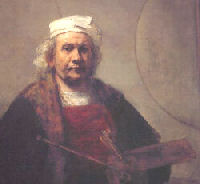
(Btw, what better example to illustrate the concept of a “digital text master” than to show the self-portrait of the great 17th century Dutch master painter, Rembrandt van Rijn, whose attention to detail and exactness is renowned.)
This is an extract from Jonathan Lethem's article on copyright in Harper's. It's a long article but well worth the read.
Literature has been in a plundered, fragmentary state for a long time. When I was thirteen I purchased an anthology of Beat writing. Immediately, and to my very great excitement, I discovered one William S. Burroughs, author of something called Naked Lunch, excerpted there in all its coruscating brilliance. Burroughs was then as radical a literary man as the world had to offer. Nothing, in all my experience of literature since, has ever had as strong an effect on my sense of the sheer possibilities of writing. Later, attempting to understand this impact, I discovered that Burroughs had incorporated snippets of other writers' texts into his work, an action I knew my teachers would have called plagiarism. Some of these borrowings had been lifted from American science fiction of the Forties and Fifties, adding a secondary shock of recognition for me. By then I knew that this “cut-up method,” as Burroughs called it, was central to whatever he thought he was doing, and that he quite literally believed it to be akin to magic. When he wrote about his process, the hairs on my neck stood up, so palpable was the excitement. Burroughs was interrogating the universe with scissors and a paste pot, and the least imitative of authors was no plagiarist at all.
Nelson W. Polsby, who marshaled intellectual rigor, lucid writing and a knack for drawing striking lessons from real-life observation in his enduring studies of Congress and the presidency, died on Tuesday at his home in Berkeley, Calif. He was 72.
The cause was complications of congestive heart failure, his daughter Emily Polsby said.
Mr. Polsby, a political scientist, wrote or edited at least 15 books and scores of articles and edited The American Political Science Review, the most prestigious political science journal. He was especially known for his studies of Congress, the presidency, political parties, policy making and the media.
The Library of Congress has received a $2-million grant from the Alfred P. Sloan Foundation to digitize public domain works. The grant emphasizes digitizing "at-risk" titles—or books that are falling apart—and volumes about American history. Dubbed "Digitizing American Imprints at the Library of Congress," the project will also allow the LoC to invest in such technology as, according to a statement from the organization, "suitable page-turner display" along with a program dedicated to quickly indexing and capturing chapters and other sections of a work.Publishers Weekly Daily, 5 February 2007